The Case of the Broken-Down Brand Guide
Unless you work in marketing, design, or another role that deals with public-facing products, you probably don’t often think about branding. It might feel like a far-off concept that has little, if anything, to do with you. But the fact is, if you’ve ever wondered where to put a logo, how big to make it, which font to use, or what tone to write in, you’re smack dab in the middle of branding territory. Chances are that someone has answered these questions for you already and all you need to do to save yourself that extra brain-juice is take a quick look at your company’s style guide.
But wait…where is your company’s style guide? Imagine that, after asking around, someone emails you a large PDF attachment titled “Company Styleguide – 2019 – version12b.pdf” that takes forever to download. Once you open it, nothing is familiar, there’s a bunch of jargon you don’t know, and there are so many pages that you go cross-eyed and decide that, after spending an hour on this seemingly “easy” question, you’d have been better off making the call yourself.
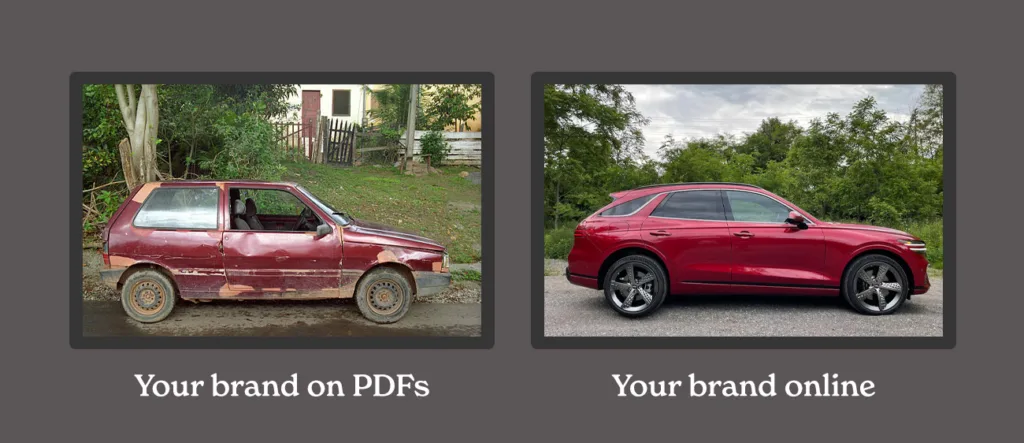
This scenario, unfortunately, is common and is a perfect example of why it’s time to finally break up with your PDF styleguide doc. I know, I know, most of us love a good PDF. But just like that beloved old car that keeps breaking down, there comes a point when you realize there’s a better, more efficient, and frankly, more enjoyable way to get where you’re going. That better way is with a sleek, intuitive, and infinitely better-adapted, online styleguide.
The Web-Based Solution and Why it Works
Remember that nightmare scenario from earlier? Now imagine that suddenly, you can simply bookmark a URL rather than having to trawl through hundreds of desktop folders, downloads, and sharepoint files to find your styleguide. You no longer have to worry about keeping track of which “version a, b, or c” file is the right one. The information you need is neatly organized right in your web browser, always up-to-date, and you can access it anywhere without having to download a thing. When you compare the two scenarios, the decision is clear. It doesn’t matter if your styleguide is 100 pages or 10, making the switch from a static PDF to a dynamic website is one that is not only smart, but necessary, for any modern brand.
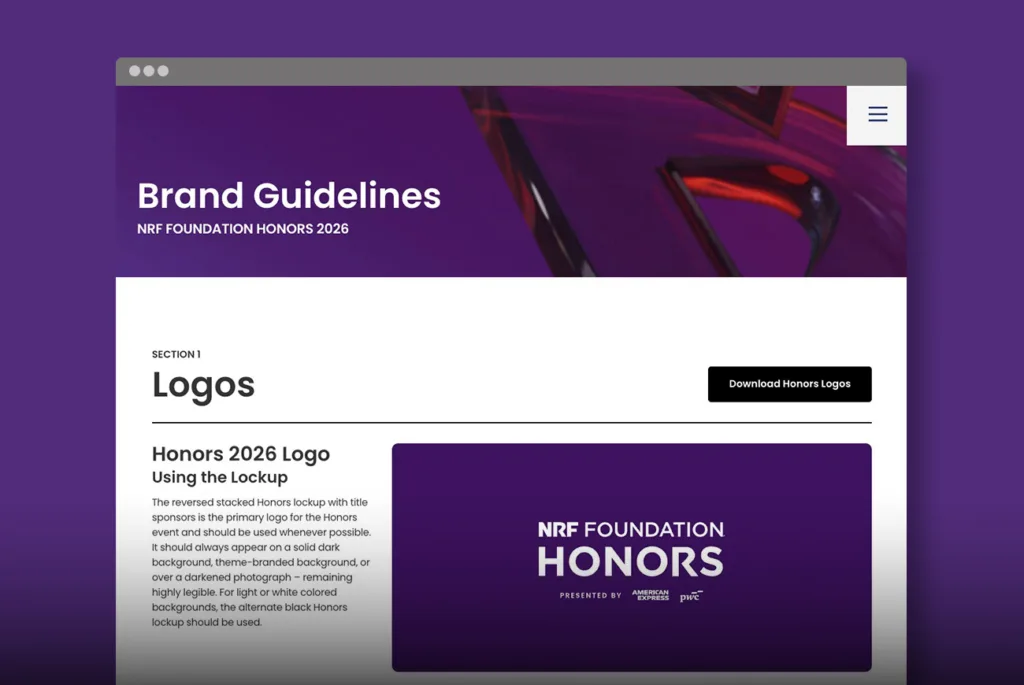
Just in case you need more convincing, let’s examine our client, the National Retail Federation (NRF) Foundation. For years we have worked with them to build the NRF Foundation Honors awards event in NYC. It comes together over 10 months, beginning every year with the reimagination of the brand and then steadily evolving to incorporate input from internal teams and external contractors as more and more deliverables are produced. We used to capture all that creative in a PDF styleguide, but this year we’ve upgraded to a website that can be edited throughout the year.
Everything You Need, Organized
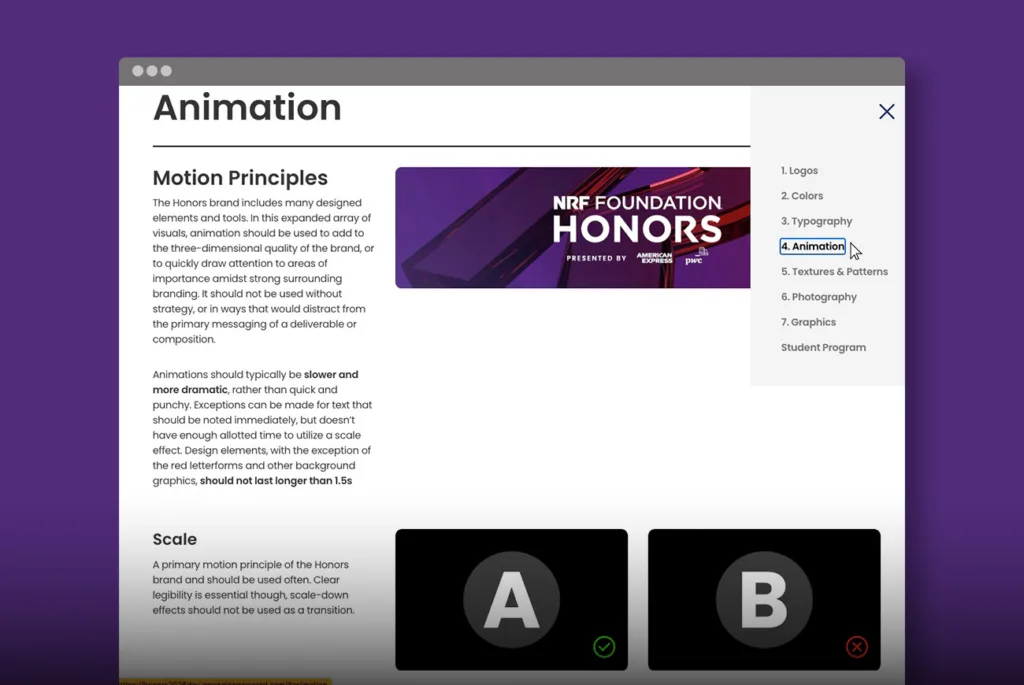
Like any other big award show, The Honors is not only an in-person event. The months preceding it are full of branded emails, the NRF Foundation website is completely remade to advertise the event, of course social media is involved, and across all these areas and production teams, the implications on the brand need to be well-documented and maintained. In order to do that effectively, people need to be able to find not only the guide itself, but the sections of it that apply to what they’re working on — and they need to do it fast. Including a navigation menu on your styleguide site makes solving this problem incredibly easy, and if that wasn’t easy enough, instant searchability makes it a no brainer. Now every team member can find anything from color codes, to downloadable logo packages, to photo effects with just a quick skim of the menu.
This improved navigability also means that we have more room to expand the styleguide to improve documentation and add nuance to the requirements. Without the constraints of file size or page count, we could dream up some much-needed guidance surrounding questions such as: “How do graphics that appear on-stage differ from social media graphics?” The ability to view these elements side-by-side in a cross-linked guide captures complex relationships and concepts in a way that PDFs simply cannot. But it gets better! Let’s dive a little deeper…
Show, Don’t Just Tell: Your Brand Guide in Motion
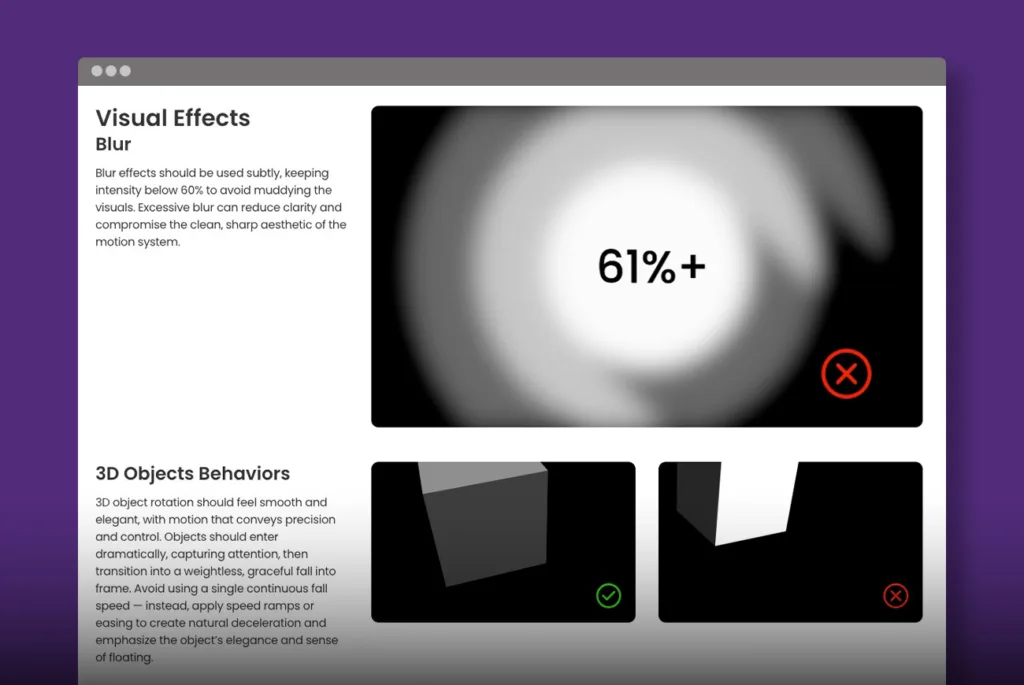
Another advantage of this strategy is the depth of detail that can be accomplished when more tools are available to build with. When it comes to aspects of the show that aren’t easily represented by static images, we found PDFs lacking once again. Take motion effects for example. In a PDF, you can’t add video without either jacking the file size up to astronomical heights, or pointing the viewer to an external link. With a website, it’s incredibly easy to add GIFs and MP4 files to supplement whatever motion concept you want to demonstrate. That’s way better than trying to type out bulleted lists describing a motion sequence! After all, being able to see examples of how all these interconnected pieces work together is half the battle of visualizing the full, cohesive brand.
Controlled Editing Access & Version Control
The final, and one of the best, cases for a website? Everyone can find it, and everyone can feel confident in its validity. (Our) websites are always online, which means that your styleguide is available on any device, anywhere, at anytime. You’ll also have full control over who can see it, who can edit it, and how many versions exist (hint: the only right answer is one!). When before, all 11 of the previously-published versions of your “Company Styleguide – 2019 – version12b.pdf” were destined to be scattered across employees’ laptops and hard drives forever, now you have full control over the one guide to rule them all. No more costly reworks of outdated or outright wrong designs, there can be no mistaking your well-maintained online guide.
Plan for the Future, Go Online Today
Ultimately it all comes back to what is going to be your team’s best, most thorough, and most reliable authority on all things branding. It’s more than preference, it’s more than technical ability, and it’s certainly more than status quo. For companies that value the integrity and consistent application of their brand, a web-based styleguide is not just the future, it’s a must-have. Anything less, while perhaps more convenient in the near-term, will open the door for confusion and unnecessary cost in the long run. So, if you’re still clinging to PDFs, I invite you to consider the possibilities that you’re giving up for the sake of routine. Drop us a line and let us help give your brand the living, breathing guide that it deserves!